When winter weather arrives in Northeast Ohio, a commercial property needs more than a truck that shows up after the snow stops. Employees need access to their workplaces, customers need navigable parking areas, and deliveries cannot wait indefinitely for a clear loading dock. At Abraxus Snow & Ice Management, we approach commercial snow removal as a coordinated process that begins before a storm and continues after the skies clear. Understanding that process helps property managers know what to expect, how to prepare, and why a reliable winter maintenance partner matters.
Step 1: We Learn Your Property Before Winter Arrives
A successful snow removal visit starts with a plan, not a plow. Before service begins, we meet with clients to walk their properties and discuss specific needs. We identify where snow can be stacked, which access routes are essential, whether sidewalks require clearing and salting, and whether on-site salt storage would be helpful. An office complex has different priorities from a medical facility, retail center, or industrial property. We use those details to develop a customized snow and ice management plan that reflects the property’s layout, traffic patterns, operating hours, and service expectations. This preparation helps our crews work efficiently when conditions become difficult.
Step 2: We Monitor Weather Before the First Snowflake
Northeast Ohio forecasts can change quickly, especially when lake-effect snow creates very different conditions across nearby communities. Our team monitors AccuWeather and National Weather Service reports and communicates with other contractors to understand both isolated and widespread events. We do not treat every forecast as an identical storm. Temperature, timing, accumulation, and the potential for freezing precipitation all affect the response. Proactive monitoring gives us an opportunity to prepare equipment and crews before conditions interfere with business operations. For property managers, that means the service process is already underway even when the parking lot still looks clear.
Step 3: Crews and Equipment Are Coordinated for the Event
As a storm develops, we coordinate dispatch around the weather and each client’s defined service plan. Our operation has access to a portfolio of more than 400 pieces of snow removal equipment, supporting plowing, snow removal, relocation, sidewalk work, and deicing. The right equipment depends on the site: a large commercial lot may require a different approach than a narrow access lane or pedestrian walkway. During significant events, service may require repeated visits rather than one final pass. Dispatch and scheduling decisions are driven by actual conditions, contract terms, and site priorities. This is why clear expectations before the season are so important.
Step 4: We Clear Parking Lots and Essential Access Routes
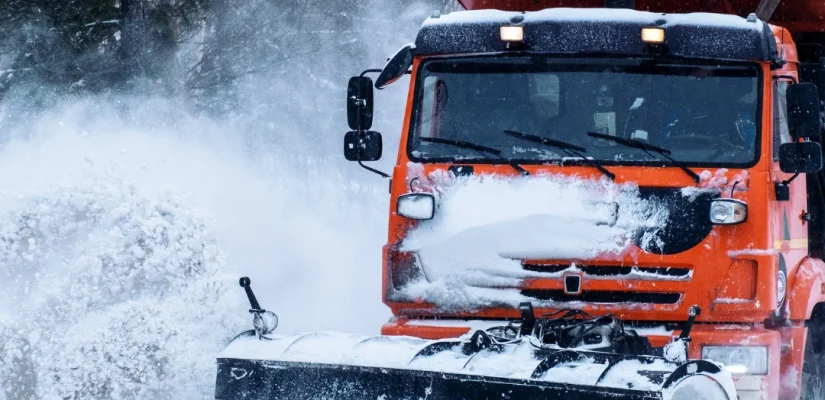
Once crews arrive, the visible work begins. Commercial snow plowing focuses on restoring usable travel paths and parking areas while working around curbs, landscaped islands, parked vehicles, and other site features. Priority areas may include building entrances, access roads, loading docks, and emergency routes, depending on the agreed scope. Snow must also be pushed or placed thoughtfully. Poorly positioned piles can obstruct sightlines, consume valuable parking spaces, or create drainage problems when temperatures rise. When accumulation exceeds available storage space, snow relocation or removal may be appropriate. Our objective is to help your property remain accessible while managing snow in a practical, organized way.
Step 5: Sidewalks and Pedestrian Areas Receive Attention
A clear parking lot is only part of a winter-ready property. Employees, patients, residents, customers, and delivery personnel also need a route from their vehicles to the door. Sidewalks, ramps, entryways, and other pedestrian spaces can accumulate packed snow or become slippery even after vehicle lanes have been plowed. Where included in the service agreement, our sidewalk teams address these areas as part of the overall site plan. We encourage property managers to identify high-traffic entrances and special access needs during the initial walkthrough. Coordinating pedestrian and vehicle services helps reduce gaps in winter maintenance coverage.
Step 6: Deicing Addresses Hazards That Plowing Cannot
Plowing removes accumulated snow, but it does not eliminate every ice hazard. Compacted snow, freezing rain, runoff, and overnight refreezing can leave slick surfaces behind. Deicing services are therefore an important component of professional snow and ice management. Through our relationship with Abraxus Salt, LLC, we have access to deicing resources that support winter operations. Material selection and application depend on pavement conditions, temperature, site requirements, and the contracted service scope. More material is not automatically better. Responsible application aims to improve traction and address ice while avoiding unnecessary product use. Property managers should understand when deicing is included and how additional applications are authorized.
Step 7: We Communicate and Document the Work
During a winter event, property managers should not have to guess whether a service visit occurred. Our crews record snow removal and ice control activity, and clients can access daily communication reports based on our around-the-clock staff activity logs. Accurate records help explain which services were performed and support informed decisions about follow-up work and winter budgets. We also offer next-day reporting for service and material usage. Documentation is especially valuable when a storm lasts many hours, conditions vary by location, or a property manager oversees multiple sites. If questions or concerns arise, our goal is to make contact promptly and address them directly.
Step 8: We Assess Conditions After the Storm
A storm ending does not always mean the property is finished with winter maintenance. Snowbanks can melt during the day and refreeze at night. Drifting can return snow to previously cleared areas. A shaded walkway may remain icy after a sunny parking lot has dried. Follow-up assessment helps identify whether additional plowing, relocation, sidewalk work, or deicing may be needed under the service agreement. Property managers can help by reporting trouble spots, changing traffic needs, or blocked access areas. The best snow response is not measured only by how quickly a plow arrives, but by how effectively the property’s needs are managed throughout the event and afterward.
What Should Property Managers Do Before the First Visit?
Review your service agreement, confirm the primary contact, and identify the most important entrances, delivery routes, and pedestrian areas. Discuss where snow should be stored and any areas that must remain unobstructed. Make sure your team understands how to report changing conditions or request additional service. We offer hourly, per-occurrence, and seasonal contract options, with the scope and pricing approach defined according to the property’s needs. Establishing those details early can prevent confusion during a busy storm. It also makes communication between your staff and our crews more productive.
Count on Abraxus Snow for Commercial Snow and Ice Management
For more than four decades, we have helped Northeast Ohio businesses prepare for and respond to challenging winter conditions. We serve commercial properties across Ashtabula, Cuyahoga, Geauga, Lake, Lorain, Medina, and Summit counties. From forecast monitoring and crew coordination to snow plowing, deicing, and post-storm reporting, our focus is dependable service built around your property. If you are evaluating commercial snow removal in Cleveland or the surrounding region, contact Abraxus Snow & Ice Management to discuss a customized winter service plan. Visit www.abraxussnow.com or call 216-321-SNOW to get started.